MOIRE.md
8.6 kB · markdown
Moiré
What happens when you stack the snowflakes on top of each other? ...Something nobody drew.
Take every odd number from 1 to 55, slice each sponge, blow all twenty-eight grams up to exactly the same size, and lay them down like sheets of tracing paper — each one faint enough that no single number gets to win.
!every odd 3D carpet from 1 to 55, stacked
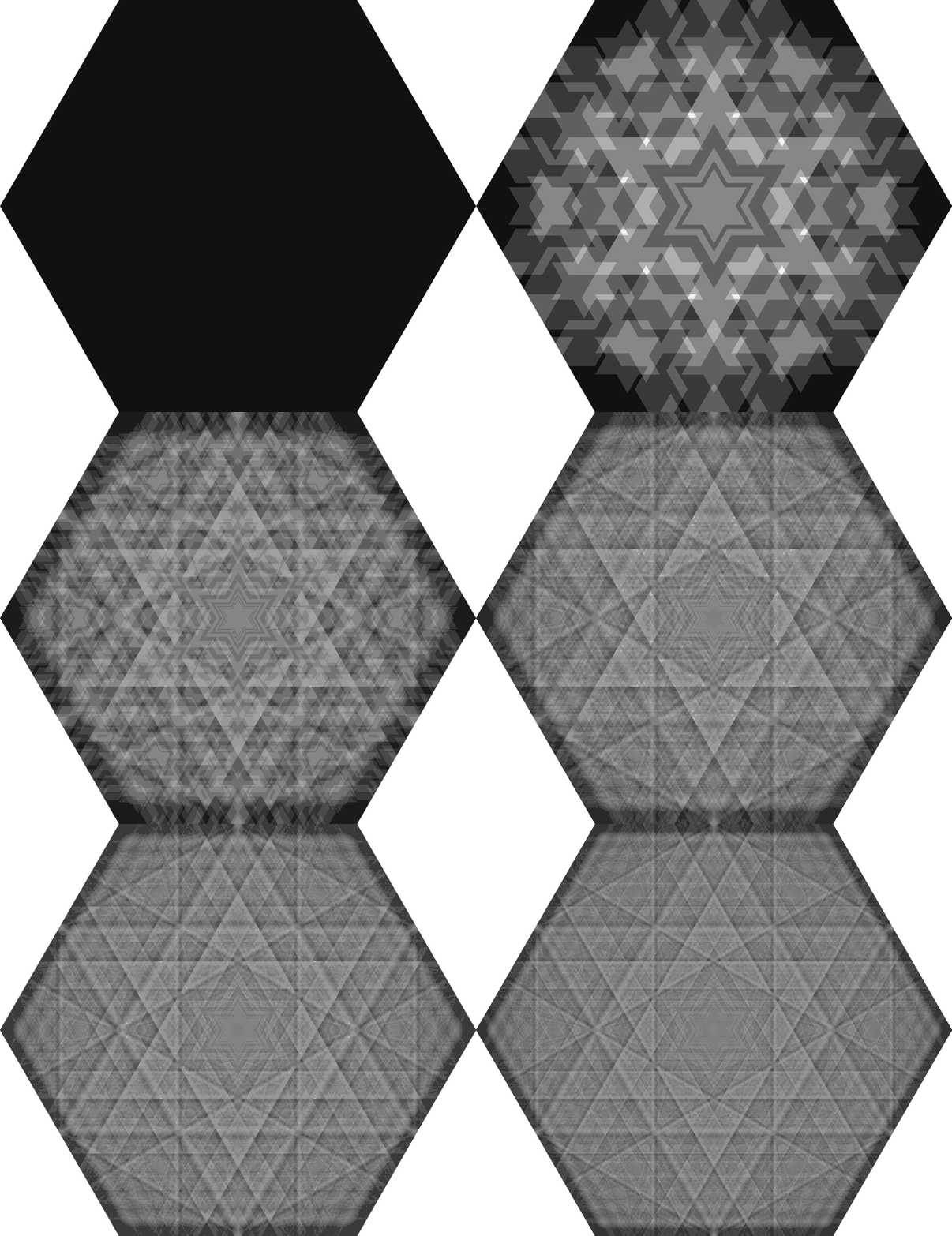
Watch it build. The first few frames are still recognizable snowflakes. Then somewhere past twenty the individual grams dissolve, and a picture surfaces that was in none of them: long straight rays crossing the whole hexagon, a ghost star at the middle, the six-fold symmetry still holding. That's moiré — the shimmer you get for free when you overlay grids of different pitch, the same one that ripples through two layers of net curtain, or across a photographed computer screen.
And it has to be there. Every gram is the same at most one odd test, just chopped finer: 1 unit across, then 3, then 5, all the way to 55. Their features land on top of each other wherever the numbers agree, and cancel wherever they don't — the bright and dark rays are a map of that agreement. Arithmetic, made visible by nothing more cunning than stacking.
The same trick works one dimension down. Here are the flat 2D carpets — the square grids from How the pictures are made — stacked the same way:
!every odd 2D carpet from 1 to 55, stacked

Squares instead of triangles, so the rays run diagonally rather than at 60°, but it's the same phenomenon: the main diagonal comes out twice as bright as the field around it. And that twice is exact — keep stacking and the ratio settles at precisely 2. (Twice the white paper showing, to be exact.) Look again: the other diagonal is its pixel-perfect twin, because every gram reads the same forwards and backwards. The picture carries a bright X. And look at the very center. That one dot alternates fill, void, fill, void as the number climbs — the same n mod 4 flip that powers the solution — so across twenty-eight numbers it settles at exactly 50/50: a perfect mid-gray pinprick at the heart of the picture.
How far can you push it? Further than you'd guess. The field between the rays does slowly gray out — barely slower than a pile of random patterns would, it turns out — but the rays themselves never dim: each one keeps its exact brightness forever and only grows thinner, so every layer you add makes the picture sharper, not blurrier. Pixels give out first: at 1080 across, somewhere past number 150 each cell is thinner than two pixels, and the finest grams quietly turn to fog. (Memory goes next — number 301 wants 1.7 GB just to hold its blown-up cube.)
Run it yourself with MIN and MAX at the top of demos/mrlygram.py:
``bash uv run demos/mrlygram.py cut carpet # the snowflakes, stacked uv run demos/mrlygram.py flat carpet # the 2D carpets, stacked uv run demos/mrlygram.py sweep # both views, all four families ``
The stack answers back
Is π lurking in here? What about the primes? We stacked, we measured, we proved — and the answers are stranger than the questions. Each headline links its paper on the research shelf, where every claim ships with a script that re-checks it.
The primes hide one dimension down. Take the flat carpets of two odd numbers, say 9 and 15, stretch them to the same size, lay one over the other, and count the cells where they agree. Strangers would agree exactly as often as chance predicts; the overshoot is their correlation. It obeys an exact law: all that matters is the greatest common divisor — the largest number dividing both. Share a factor, as 9 and 15 share 3, and the carpets echo each other by a precise, positive fraction. Share none, as 9 and 25, and the correlation is exactly zero. Not tiny, not zero-to-five-decimals: zero, as a proved fraction. So an odd number is prime exactly when its carpet is a total stranger to every carpet before it. Draw the times-table of these agreements and the primes are its all-white rows:
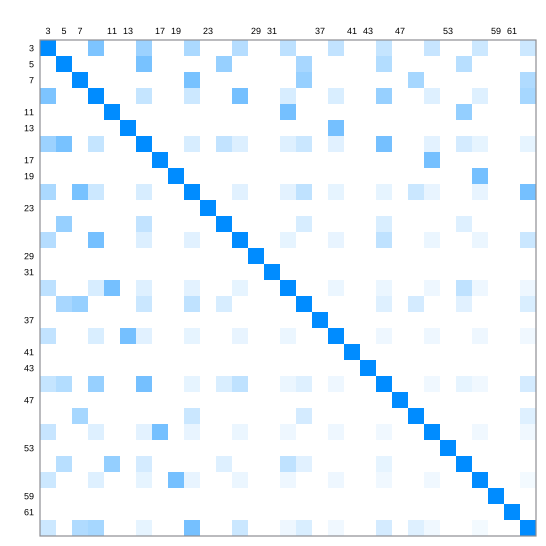
One honest footnote: this is a portrait of primality, not a shortcut to it — testing "is the correlation zero?" costs about as much as plain old trial division. The picture doesn't beat the arithmetic; it is the arithmetic, drawn. The paper: Parity Carpets Correlate by gcd.
The snowflakes refuse to obey. The diagonal cut smuggles a faint overtone into every snowflake — an extra wave vibrating twice as fast — and that overtone lets snowflake m whisper to snowflakes 2m−1 and 2m+1, its almost-doubles, even when the numbers share no factor. Coprime no longer means stranger; the slice carries gossip of its own. That write-up is still on the workbench.
Pi plays a magic trick. Why are all those agreement numbers plain fractions — where's π? It enters twice and cancels itself. Every stripe pattern here is secretly a sum of smooth waves — Fourier's old trick — and building a sharp-edged stripe out of smooth waves costs a factor of 4/π, so every ingredient is soaked in π. But a strength you can actually see compares waves against waves, which squares the π on top — and the bottom of the same fraction sums the series 1 + 1/9 + 1/25 + ⋯, which happens to be exactly π²/8. Top π², bottom π², gone — every time. That's the theorem behind "the diagonal is exactly twice the field": every visible strength in these stacks is a plain fraction, and π lives only in the machinery. (Same paper as the primes.)
Count instead of measure, and π steps back out. Mark a grid point when its two coordinates share no factor — the same coprime test, drawn as one picture instead of a stack. Those are exactly the points you can see from the corner of the grid; every other point hides behind a nearer one on its line of sight. The visible share of the grid creeps toward 6/π² ≈ 60.79%, so counting cells in a big enough picture and taking a square root spits out π: a 100,000-wide grid delivers 3.14158 by counting alone. And the census survives on the fractals: restricted to a fractal's own cells the density is still a clean fraction times the classical one — for the Sierpinski gasket, exactly 16/(3π²) — proved in Coprimality Density Above Dimension One. One dimension up the census trades π for Apéry's constant, and Menger Pairwise Coprimality prices the sponge itself: drilling its holes costs the coordinates exactly 12.25% of their coprimality odds. Stranger constants — ink budgets creeping toward Catalan's constant, a number nobody has even proved isn't secretly a fraction — are still on the workbench.
The brightest lines have names. The strongest rays crossing the stacked snowflake sit at the quarter marks of its width, and their strength is an exact step of one eighth — 0.125 — that every single layer votes for identically: the measured step reads 0.1245 by twelve hundred layers and is still creeping in. That one is still on the workbench too.
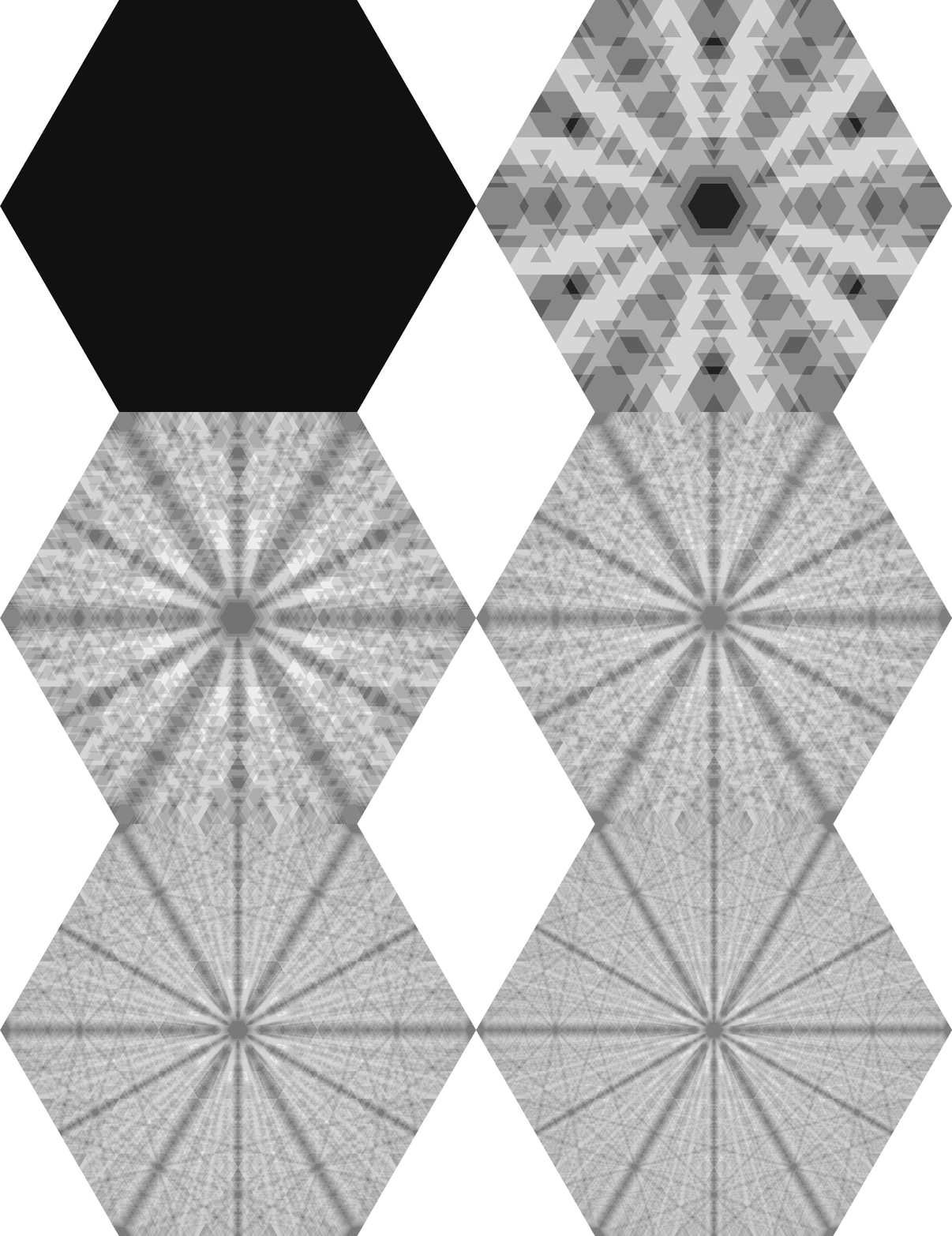
And recipes have fingerprints. Our sponge comes from one little parity test, but in 3D there are exactly 256 such tests — a whole zoo of sponges. The slice of any of them prints its own recipe: the hexagon's ink fraction follows one exact formula, valid for all 256 recipes at every odd number, and the formula's coefficients are the recipe's fingerprint — its Walsh spectrum, the signal-processing kind. Point the slice at a mystery sponge and it reads the recipe back; that's The Walsh Spectrometer. The leapfrog from the bonus solution is in there too: some recipes blink — one layer mostly ink, the next mostly paper — and the blink's size is exactly minus half of one particular fingerprint number, so the recipe tells you, before a single triangle is drawn, whether its stack blinks or holds steady. The void family is the showstopper: its stack keeps a twelve-armed star and a jet-black center dot forever, while the carpet's ghost star slowly dissolves into the gray.
!every odd 3D void from 1 to 55, stacked
The full hunt — teams of AI agents checking each other's work, refuting each other freely — lives on the research shelf, and more papers are landing.